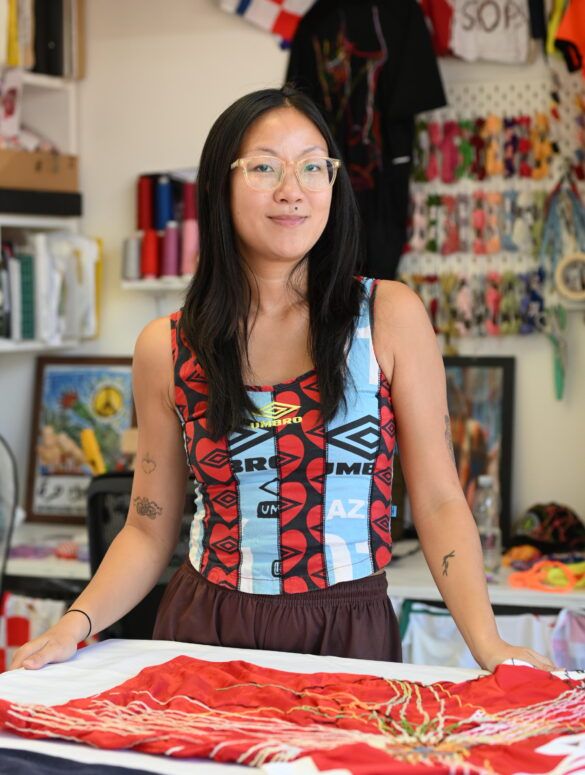
Walking into Nicole Chui’s studio at Blackhorse Workshop Studios in East London feels less like entering a workspace and more like stepping into a living archive of memories. Football shirts embroidered with swirling threads hang beside delicate paper works, while rolls of colourful yarn spill across worktables. It is a place where sport, textile art and community intersect.
Known for transforming football jerseys into richly embroidered artworks, Chui has developed a distinctive artistic practice that explores identity, migration, family and belonging. During our visit, we spoke about how embroidery has connected her to her roots, how football unexpectedly became central to her work, and why community lies at the heart of everything she creates.
– Your studio immediately feels welcoming and personal. Does the space influence the way you work?
Absolutely. Being surrounded by other makers is really important. There are woodworkers, metal fabricators and furniture designers here, and everyone inspires one another and collaborates. It never feels isolated. My work is about community, so it makes sense that I create it within one.
Looking around the studio, unfinished works sit comfortably beside completed pieces. Nothing appears rushed. “I never really know how a piece will end,” she laughs. “They’re all based on emotion.” Rather than following rigid plans, Nicole allows each artwork to evolve naturally.
“I like giving the work time to breathe. Sometimes I’ll leave a piece for days before coming back to it.”
– Embroidery has been part of your life for a long time. Where did it all begin?
My grandmother taught me embroidery when I was fifteen.
As she speaks, her expression softens. Her grandmother, who passed away earlier this year, remains one of the strongest influences on her practice.
“I’ve always loved thread,” she says. “There’s something very tactile about it.” For Nicole, embroidery is far more than a craft; it is a way of preserving memory. Every stitch carries the legacy of family and the quiet rituals passed from one generation to the next.
One of her most personal works, Judy, named after her grandmother’s English name, combines hand embroidery with vintage crochet inherited through her partner’s family. Inspired by Malaysian batik patterns, it brings together two family histories through textile.
– Football seems like a very different world from embroidery. How did the two become connected?
Nicole smiles.
“I actually grew up playing football in Hong Kong. My dad loved football and encouraged all four of us sisters to play.”
After the pandemic, football returned to her life in an unexpected way. An Adidas workshop invited her to customise football shirts with embroidery, and one jersey was left behind after the session. “I took it home and started stitching over the badge.” That simple experiment transformed her artistic practice.
“The badge sits over your heart,” she explains. “I wanted the embroidery to feel like the passion coming out from there.” Today, football shirts have become the canvas through which Nicole explores identity, migration and belonging.
– Your work is deeply connected to community, not only through art but also through football itself.
Three years ago, Nicole founded Base FC, a football club for women, trans and non-binary people of Asian heritage in East London. “What started as a football team became a community,” she says.
Having lived in London for more than a decade, she understands how lonely moving to a new city can be. “I know how difficult it is when you first move here and don’t know anyone.” Football changed that. “I see these people more than some of my oldest friends.”
As she speaks, it becomes clear that the values behind Base FC are the same ones stitched into every artwork: inclusion, care and belonging.
– One phrase appears throughout your work: Grassroots Never Dies. What does it mean to you?
“It’s about doing what we believe in,” she replies. “Not what authority tells us to do.”
For Nicole, grassroots culture represents independence, creativity and the power of communities to shape their own future.That philosophy also explains why she continues to embroider every piece by hand. “Hand embroidery gives me complete freedom.”

– You’ve collaborated with brands such as Nike, Adidas and Google Pixel. How do you maintain your artistic identity, and what have those collaborations meant for you?
“They’ve hired me because of my style,” she says.
Rather than changing her work to fit commercial projects, Nicole sees collaborations as opportunities to bring her artistic language to wider audiences while supporting the reality of sustaining an independent studio practice.
– Where do you see your work evolving next?
Nicole looks around her studio.”There are no limits.”
She began working with paper before expanding into embroidered football shirts, keyrings and bags. Now she is exploring how her practice can grow into new materials and objects while remaining true to her distinctive style.
She also dreams of collaborating with professional women’s football players, creating embroidered goalkeeper gloves that demonstrate both the beauty and durability of hand stitching.
“I want people to see that these pieces can actually be worn.”
– Finally, what advice would you give young artists?
Her answer is immediate. “Be consistent. Make work that’s true to who you are.” She believes technology has its place, but nothing can replace the knowledge that comes from making something with your own hands.
“There are no shortcuts.”
Leaving Nicole Chui’s studio, one thing becomes unmistakably clear: her embroidery is never simply decorative. It is a language through which football becomes culture, family becomes memory and community becomes something tangible, stitched carefully, patiently and by hand. In Nicole’s work, every thread tells a story, and every story begins with connection.