Making a Rukus! At Somerset House.
“Making a Rukus”, a celebration of the vibrant lives, creative expressions and collective resistance, activism, community and pride of Black LGBTQIA+ people.
This is an exhibition that comes with a content warning: nudity, strong language, HIV and AIDS, discrimination and sexually explicit imagery. But what else would you expect from an exhibition entitled Making a rukus! Black Queer Histories through love and resistance? an exhibition that seeks to set the record straight on what being Black and Queer really means.
The exhibition occupies four rooms in Somerset House’s South Wing. Upon entry into the first room, a message from the curator and co-founder of rukus! Federation, Topher Campbell, informs us that this is the largest exhibition of the rukus! Archive to date. What is the rukus! Archive? It is evidenced all around this room and the other rooms that follow: newspaper clippings, magazines, flyers, leaflets, books, photographs and exhibition materials are arranged in glass-covered displays.
These materials tell the histories, realities and experiences of the Black Queer community. You can see the article Back To Our Roots published in the Gay Times in 2025 and read Campbell’s experience of trying to get into gay clubs in the early 90s. It wasn’t easy. In London he had to list off all the gay venues he knew before he would be let in, but out of London, he was just point blank refused entry. Reading about this bare-faced discrimination of the past may cause some to reflect that things have improved for marginalised communities today, but that can’t be taken as a blanket statement. As a young Black Queer person myself (I’m under 30 – just), I see this exhibition as holding up a mirror to the past – it reflects the present. I read these accounts and think of things that have happened in my lifetime, to me, or to others I have heard about in the news. The stereotypes have not gone away.
Some of the most arresting imagery in the exhibition is the photographic work. Mouth 3 (1993) by fellow co-founder of rukus! Federation, Ajamu X, is a closeup image if Topher Campbell’s grimacing face lying against the floor. Ajamu X’s work explores themes of eroticism, pleasure and sensuality through the medium of black and white darkroom photography. The closeness of the image is deeply intimate. The pores, the spots, the fine lines on Campbell’s face are all visible. His brow is furrowed and his teeth are bared in extasy? in anguish? It is hard not to see the duel interpretation of pain and pleasure in an exhibition that celebrates sex and love while also shining a light on discrimination and racism.
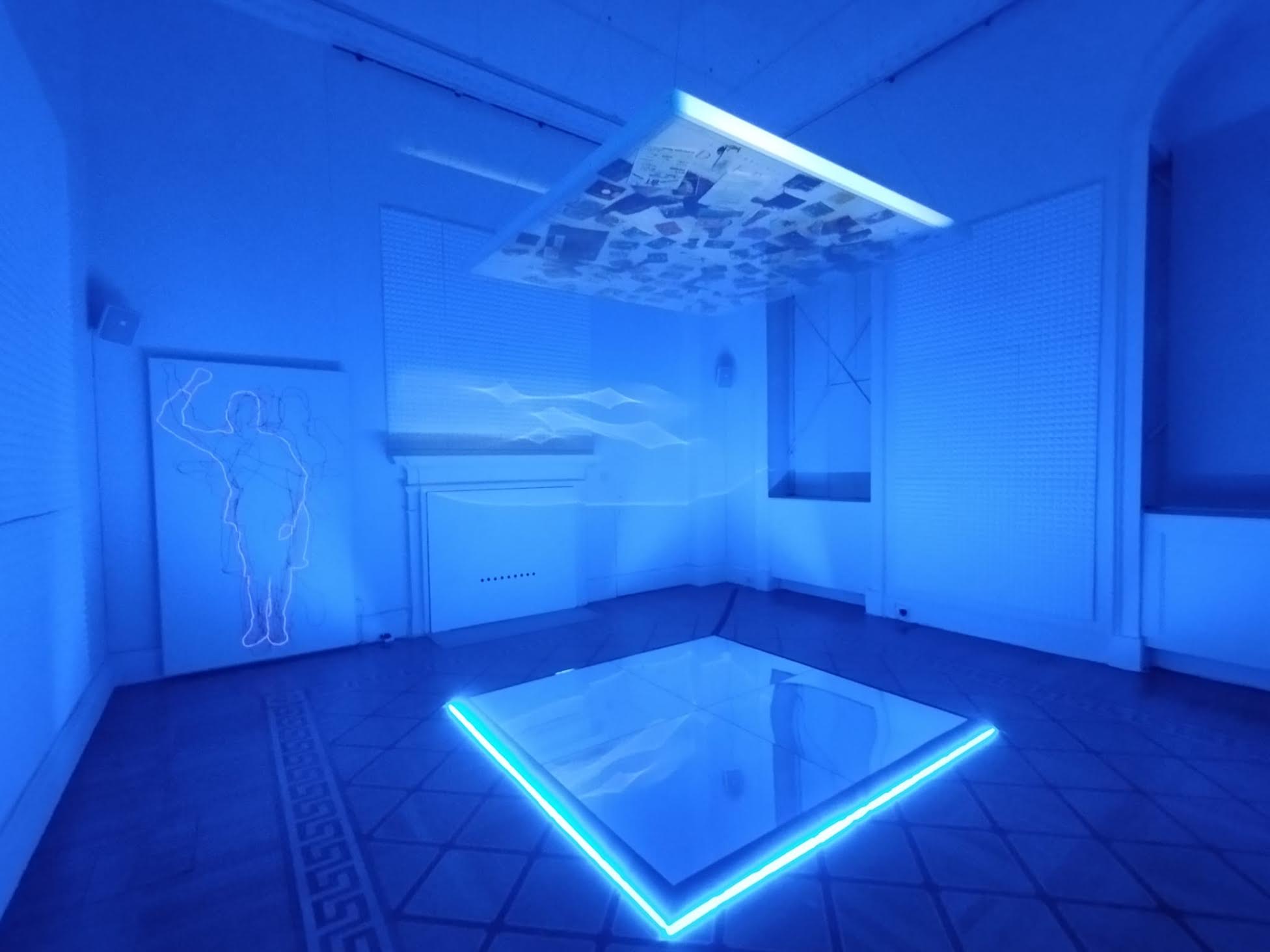
The penultimate room features Evan Ifekoya’s club installation piece A Score, A Groove, A Phantom, A rukus! (2016-2024). The room is bathed in a neon blue light. A large square mirror on the floor reflects an array of club flyers and cards; a panel on the wall shows the outline on a neon clubgoer, dancing to the sounds of an ethereal, echoing voice. This “offering” from Ifekoya highlights the importance of nightclubs for Queer people in general and Black Queer people in particular as a safe space to experiment, explore and live one’s true identity. Topher Cambell asks: “How do we archive the time we had our first kiss, or danced close for the first time with a person we were attracted to?” Evan Ifekoya’s installation is a creation that answers those questions.
Making a rukus! is a recent-historical exhibition of our time. It documents lives and experiences of people who experienced love, lived through trauma and faced resistance. It is unapologetic in its telling of these stories. This is an exhibition for everyone. For older Queer Black people to reminisce, to reflect, to laugh and to cry. For non-black and non-queer people to learn, to attempt to understand, to see a different perspective. For young Queer people to be inspired, to see themselves, to have hope.
Making a rukus! is at Somerset House until 19 January 2025.
Photo and Article: Toni Roberts.