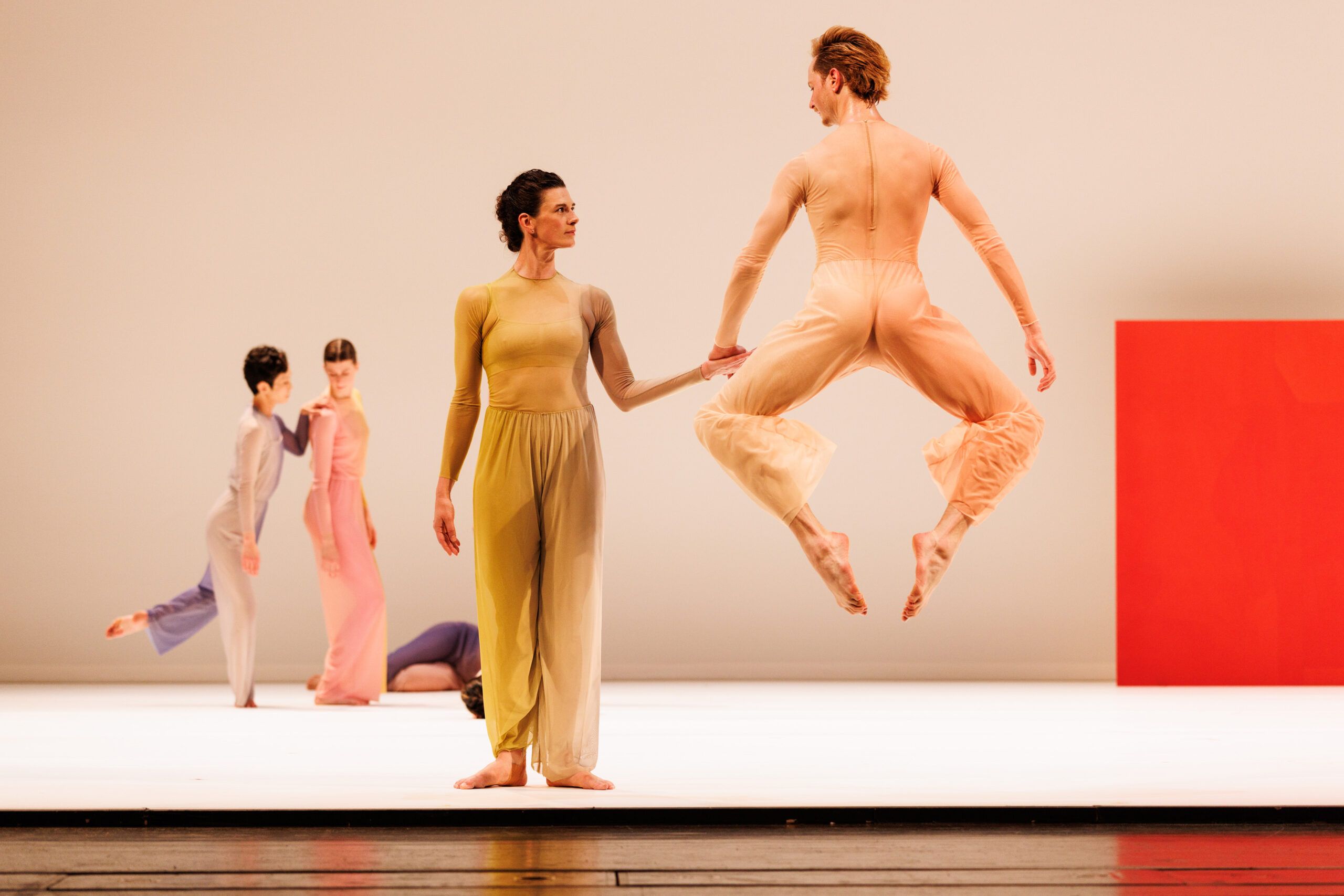
The work takes Beethoven’s Symphony No. 6, the Pastoral Symphony, as its starting point. Rather than simply recreating the original, the artists use Beethoven’s music as a framework for exploring new possibilities through dance, painting and sound.
In an online conversation spanning New York, and Spain, Le Gist Magazine spoke with Tanowitz and Crowner about how the collaboration began, how their different artistic practices came together, and what happens when painting, music and movement are developed alongside one another.
How did the idea for Pastoral first begin?
Sarah Crowner: The first time Pam and I met, it was kind of a blind date. We were introduced by a mutual friend and colleague. I was aware of Pam’s work, and Pam knew a little bit about mine, but we’d never met before.
Pam and Gideon Lester, the director of the Fisher Center at Bard, came to my studio. We sat around, looked at the work and started talking about this idea that Pam had been developing: making a dance to Beethoven’s Pastoral Symphony.
It was really in the beginning stages, but Pam and I immediately hit it off. We realised that we had a lot of similarities in the way we think and work. I was talking about how I make my paintings. I often work with large painted pieces of canvas, arranging them on the floor, sewing them together and stretching them into large-scale paintings. Then sometimes I’ll take them down, cut them up and start again.
I’ll take shapes from previous paintings or rearrange a composition that isn’t working and remix it into something different. There’s a sense of reusing and rearranging past motifs, shapes, colours and forms to create something new. I think that really resonated with Pam and the way she works with choreography, particularly the idea of taking movements and gestures and bringing them back into a new context.
Pam Tanowitz: I definitely steal from myself, but I think of it as part of a continuation of the work. It’s about taking something you’ve already made and seeing where it can go next.
Sarah Crowner: And Caroline Shaw works in a similar way. We all have a kind of simpatico way of thinking about making work, highlighting things we’ve done before, bringing something that was in the background of one work to the foreground of another.
At the same time, we’re obviously very different artists, working in different formats. I think that’s what made the collaboration so interesting. We were able to highlight each other’s work in unexpected ways.
Pam Tanowitz: As far as the initial idea for Pastoral, it was really just an idea. There’s nothing particularly magical about it. I was going to do Vivaldi, and then I changed my mind and decided on Beethoven.
People sometimes ask this question expecting some magical story, but really, it’s because I was interested.
Part of what I’m interested in is taking iconic masterpieces from the past and filtering them through my own lens. I’ve made a piece to the Goldberg Variations. It’s about taking something that already exists and seeing what happens when you look at it from a different perspective.
Sarah Crowner: That’s something Pam, Caroline and I all have in common. We can take a historical reference a piece of music, a painting, a movement and use it as a catalyst for opening up a completely different universe.
I’ll sometimes look at an artist like Matisse and become obsessed with a tiny fragment of a much larger painting. Maybe it’s just a little curve in the corner. I’ll copy or “steal” that curve, and it might become the starting point for an entire body of work.
Caroline did something similar with Beethoven. She took fragments from the Pastoral Symphony and expanded them into contemporary sounds and her own original composition. It felt very connected to the way Pam and I work.
The word “pastoral” carries a lot of history. How did you approach that idea?
Pam Tanowitz: We had a lot of conversations about the word pastoral what it meant in painting and literature, and what it means now.
Initially, we talked about deconstructing the idea of the pastoral. But in the end, that didn’t feel right. The word “deconstruction” felt too negative because the piece itself is very positive.
It’s bright. It’s bright in its colours, in the way it’s presented, and in its content and style. It’s not really deconstructed at all. It’s more like a reconstruction.
Sarah Crowner: Exactly. People kept describing the piece as a “deconstruction of Pastoral” in interviews and press releases, and we were always saying, “No, that’s not really the right word.” It felt negative as though we were taking something apart or destroying it. What we were actually doing was building something.
Pam Tanowitz: And that’s one of the difficulties of having to write press releases before you’ve actually made the work. People need information, so you come up with an idea and then sometimes that idea sticks with you even when you’ve realised it’s not quite right.
How did the collaboration change once you were actually in the studio?
Sarah Crowner: So many things happened spontaneously. I had made my paintings and Pam had ideas about the choreography, while Caroline had her music. But once we got onto the stage, particularly in the week or two before the performances, so much changed in real time.
I normally don’t work that way. When I make a painting, it’s usually a finished, fixed object. It’s done, it goes into an exhibition, and that’s that.
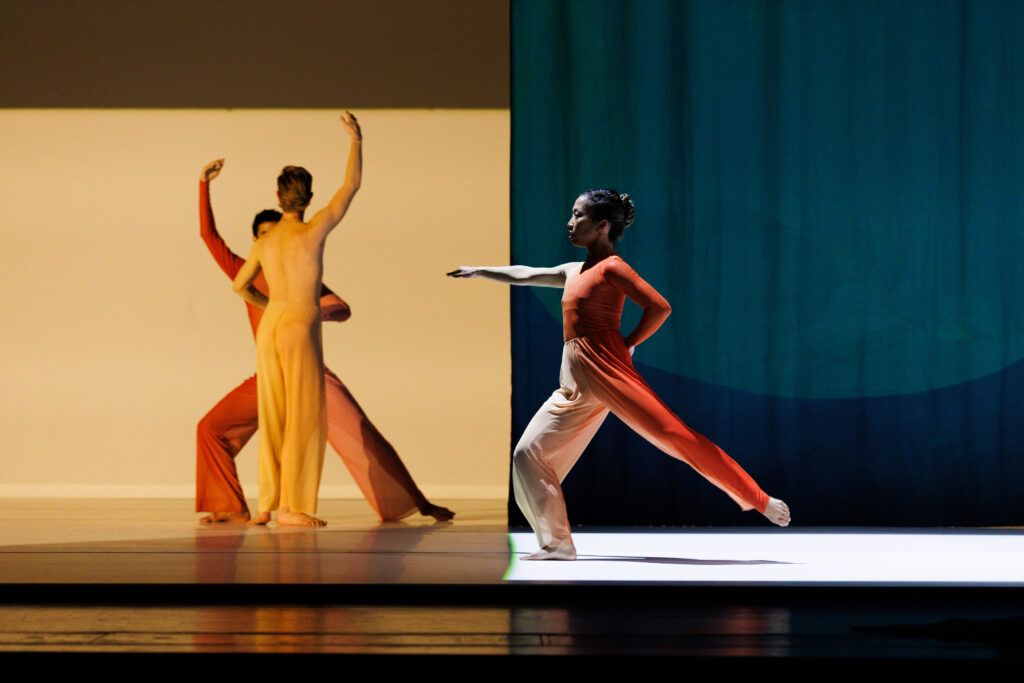
Here, suddenly, we could ask: “What if this painting were rotated upside down?” Or: “What if this painting were slowly lowered from the rafters while someone danced around it?” Pam brought ideas about gesture and movement to my paintings, and those ideas completely changed them for the better. It was a new experience for me to work in real time and remain spontaneous almost until the last moment.
Pam Tanowitz: The same thing happened with Caroline. She came into the studio with sounds already on her computer and musicians with certain things they were going to play. But as I was choreographing, she was changing things around and making things in the moment.
Between the paintings and the music, it became the most collaborative work I’ve made. Everything was happening in real time. It feels fresh and of the moment, rather than something that has already been sealed up and is ready to go. It feels alive in an interesting way.
What did trust mean within a collaboration between three different disciplines?
Pam Tanowitz: I think a good collaboration requires you to trust your collaborators.
We all had this idea of landscape and scenery and what that could mean, but I didn’t tell Sarah what to do, and I didn’t tell Caroline what to do. I completely trusted them. Even though Sarah and I had only just met, there was a good feeling between us. And I think that trust is really important.
I had worked with Caroline before, using a lot of her already composed works. She’s very busy, so I had to ask her years in advance. I kind of tricked her into doing this, actually, because originally the piece was going to be mostly in silence. I told her, “You just need to make about 20 minutes of music.” She made about an hour’s worth of music.
Sarah Crowner: In the beginning, we thought it was going to be very minimal.
Pam Tanowitz: It turned into something very maximal.
Sarah, how did you translate your painting language onto the stage, literally or metaphorically?
Sarah Crowner: Literally both.
I made actual paintings that look like the paintings you see on stage the red painting, the yellow painting and the large green one. I made them at different scales. The red painting exists at exactly that scale in real life, while the green painting and the green curtains, which are based on other paintings, are much larger.
Rather than putting the original paintings directly on stage, we photographed them beautifully and had the images printed to look like real paintings. They were then stretched around stretcher bars, which the dancers could carry and move around. Metaphorically, it started with the conversations Pam and I had about the word Pastoral and the idea of an idealised relationship with nature.
My paintings already have something of that quality. Earlier in 2024, I had made a body of work based on images looking out of my studio window. There was a willow tree outside, and I was looking at the different forms created by the leaves and the changing shades of green in summer.
So I was thinking about nature, but I was also drawing on my own past work and using it to make these new compositions specifically for the performance.
Pam, how did you begin approaching the choreography, and how did Sarah’s visual work influence the movement?
Pam Tanowitz: I just start with movement in the studio. I think I started in silence, and then I actually choreographed to the original Beethoven Pastoral. Then I took it away and rearranged it. I’m very intuitive. I can’t really tell you exactly how I choreograph. Actually, we’re in rehearsal right now, and I look at my dances and have no idea how they’re made. That is actually a really good thing, because I don’t want to be able to say, “That’s what I did there and that’s what I did there.”
If it’s more like, “How did that happen?”, to me that feels interesting. As far as exact steps and things like that, I just go to the studio and make things. It’s not literal. I wasn’t saying, “I’m doing this part of nature in this step.” That’s not really how I work.
Sarah Crowner: I totally understand that. When people ask me where a colour comes from, or how I choose something, more and more I’m just starting to say, “It’s instinct.” And then I let people deal with that. It’s just instinct.
I was looking out the window and, sure, I was spacing out looking at the window, but I wasn’t sitting there with a pencil recreating a particular thing. It was more like a feeling. I do research too. I listen to the music. I’ve read about pastoral. I talked to Pam about what it means in painting. I’ve read about Beethoven. I do separate research, but I don’t think of that as the only source of the work. It’s kind of like two things happening simultaneously.
What does Pastoral mean to you now?
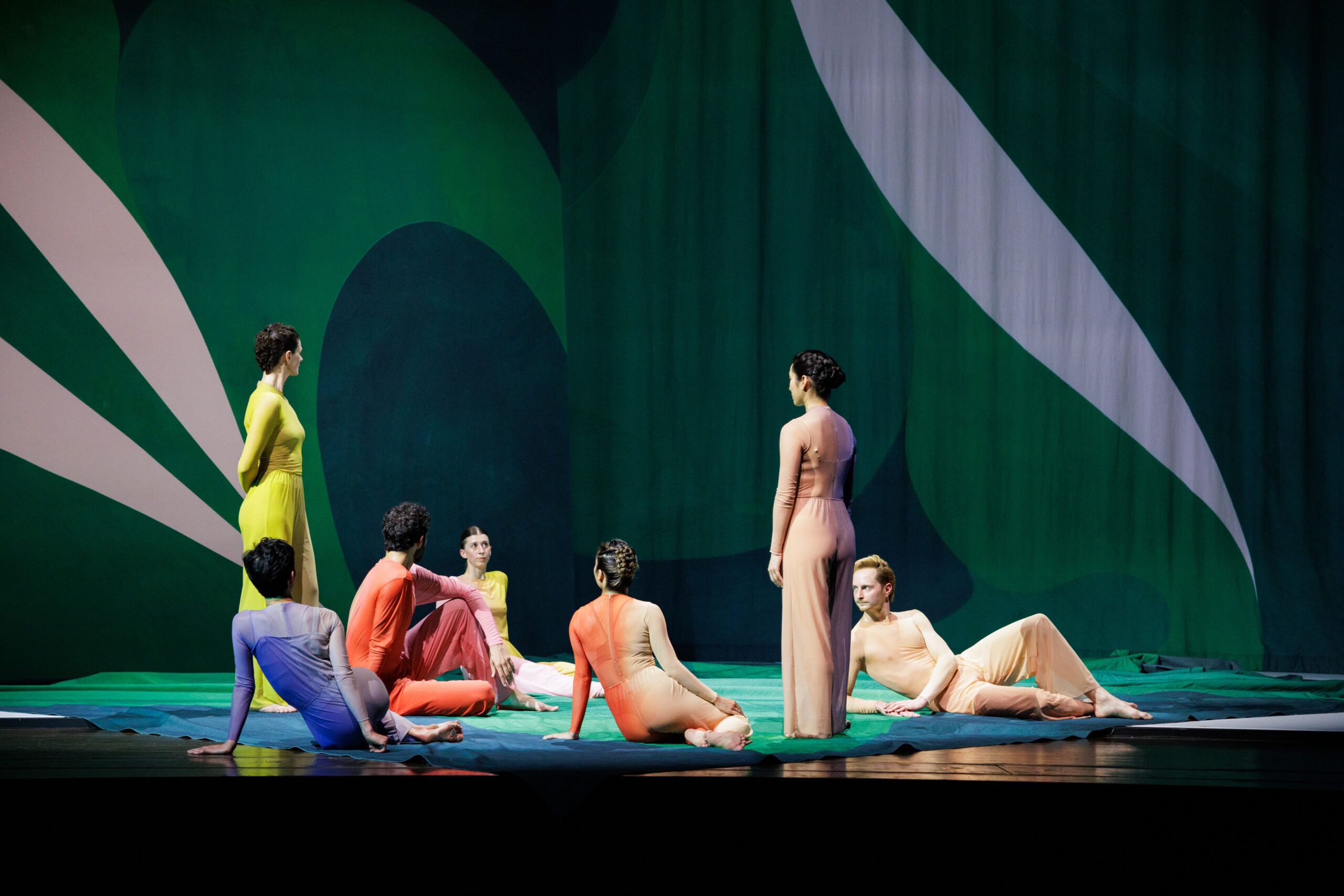
Sarah Crowner: We’ve talked about pastoral as an idealised version of nature. But what I saw happening in our dance was the dancers becoming part of the landscape, entering the paintings, entering the landscape in a way that was very collaborative and collective.
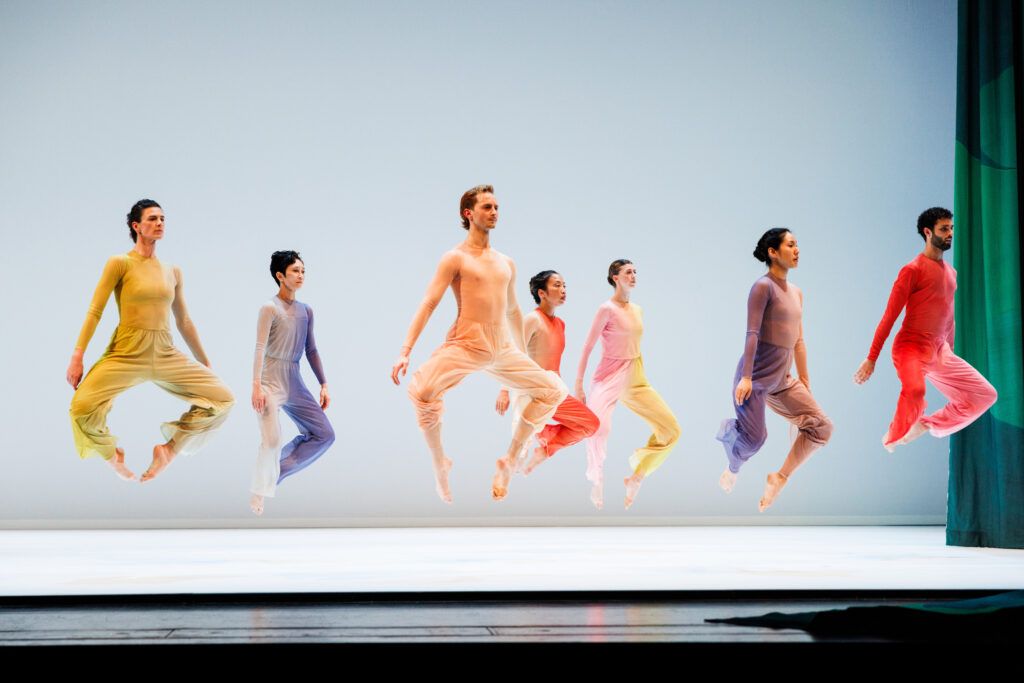
There was always a sense of a collective. There are moments where you have all the dancers together, and they kind of enter the scenery in a way that I had never seen before.
I don’t mean they literally entered it, but they kind of literally did, because at one point they were all standing on the backdrop. They were standing on a green drop cloth, so they were literally standing on the painting, standing on the landscape. At one point their backs were facing the audience and their faces were looking at the painting, but they had also entered it because it was big enough to contain them all.

To me, maybe that’s what pastoral is. It’s the body entering nature, entering a scene and becoming one thing. That sounds like a utopian dream, but there was a little bit of that in the piece.
Pam Tanowitz: It’s not just nature. We talked about people who live in the city and love being in New York City or any city. The honking and the traffic become our landscape. There’s a section of the music that does sound very much like John Cage. There’s traffic and honking, silverware, people doing dishes and things like that.
So it doesn’t only have to be about nature. There’s obviously a lot about nature, but I think it’s abstract enough that it can lend itself to multiple viewings and multiple interpretations. It’s not a literal story about being in nature. I think pastoral as an idea, whether that means the city or the countryside, or as part of art, as in an idealised pastoral in a painting can mean many things.
Sarah Crowner: We also talked a lot about my actual studio. That’s why some parts of the dance, when the scenery goes away, look like an artist’s studio. We were very inspired by my studio, the white floor and the light coming through the different windows.
Pam Tanowitz: And the group was very important to me in this piece. A lot of my work has solos and duets, but in this piece, more than any other, I was very conscious of the group. The group was very important. This piece feels much less sectional than some of my other work. It’s more about the group than any individual. Maybe I was inspired by the possible utopia of that world, but it wasn’t something I specifically set out to do.
How do you balance Beethoven’s original work with the freedom to reinvent it?
Pam Tanowitz: Beethoven’s original work is already preserved. We didn’t take anything away from it. People can listen to the original, and if they don’t want to see our piece, they can go and listen to it. We’re not taking anything away. We’re simply inspired by it. It’s our framework that we get to play in.
Sarah Crowner: We’re not scared.
Pam Tanowitz: Why should we be scared? People can be too precious about these things. It’s fine. It’s all good.
What did each of you learn from the other through this collaboration?
Pam Tanowitz: I think it was the idea I mentioned before that this felt like a really full collaboration, which I hadn’t experienced before. Making decisions about the art and Sarah’s paintings in real time, and working with Caroline in real time, was something I had never done before.
I don’t know if that’s “learning”, but it felt exciting to me. I learned that this kind of collaboration feels important to me, actually. I would want to seek out doing that again.
Sarah Crowner: It made me think about my own paintings in a very different way. It made me think of them as more active and less passive.
I never really think of them as passive or decorative in the first place, but generally, when one thinks of a painting, we think of it sitting on a wall. It just sits there, and that’s the end of that. This was a different way of thinking about paintings as human beings, or as actual protagonists in some kind of event. It was a very different conceptual way to think about what a painting is, what it can be and what it could be. That was really exciting to me. A painting can move.
Every time Mark, the dancer wearing the pink costume, stood in front of the red painting I made, I would think, “Oh, that’s a composition.” Then he would move, and I would think, “Oh, when he does that, it’s a new composition.” It gave me ideas for new paintings. It gave me about ten ideas for a new painting. So it became this thing where not only are the paintings doing something, but they’re actually generating new lives outside of this performance. The performance became a catalyst for all these other possibilities for what paintings can do.
Making them active again, instead of something passive or stiff, is really exciting. It’s the way I want to think about painting going forward for myself. And I want to do more collaborations like this.
Pam Tanowitz: Working with Sarah’s paintings also made me think about space in a different way, and about the composition of my dances. What was really important to me when we started working was that I wanted to change the space as the dance unfolded.
What would you like audiences to take away after they leave the theatre?
Pam Tanowitz: Whatever they experience, I can’t really say I want them to feel a certain way. I can only say how I feel, which is good. I feel good.
Sarah Crowner: I want them to be engaged in art.
Pam Tanowitz: I make dances to engage with audiences, to have a present audience. It’s not like they’re sitting back being entertained; they’re actually engaged in viewing it.
That’s the most important thing to me, whether they like it or not. I mean, I hope they like it, but if it’s compelling enough that they stay with it, I think that’s important.
Sarah Crowner: I agree.
Photos: Pastoral — Credit Maria Baranova / Barbican Centre.