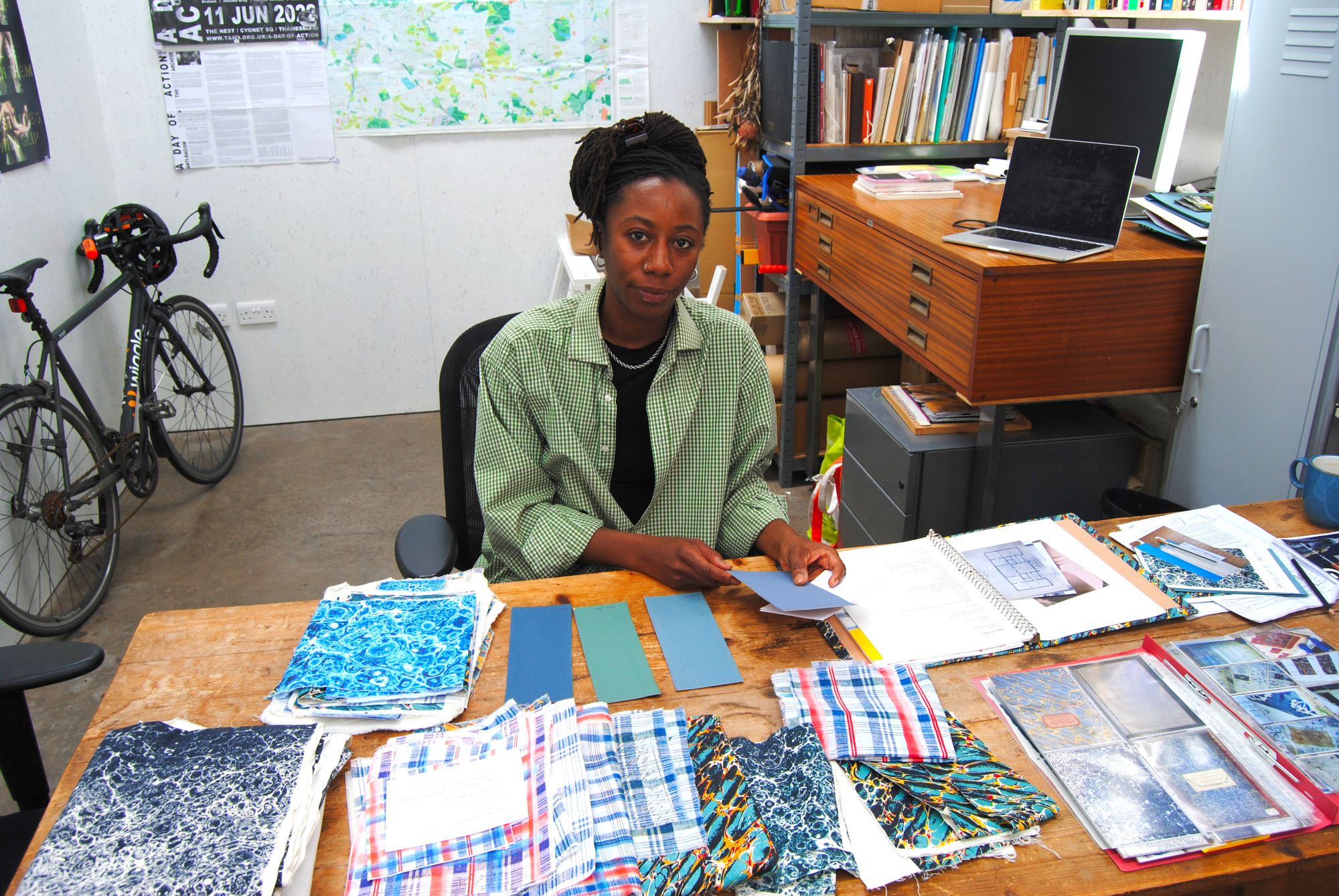
Le Gist Magazine visits Holly Graham at her studio at Studio Voltaire in Clapham, South London, where shelves of archival books, fabric studies, and unfinished works gather into something closer to an evolving archive than a traditional workspace.
Working across printmaking, sculpture, sound, and installation, Graham explores the ways histories continue to echo through the present — often through materials marked by memory, labor, and institutional histories.
During our conversation, she reflects on Warp / The Weft / The Wake, presented at Manchester Art Gallery, a project tracing the intertwined legacies of cotton, enslavement, and industrial production through material research and collaborative making. At the center of the work is a handcrafted garment developed alongside her mother, layered with references to Sarah Parker Remond and the historical circulation of “Manchester Check” cloth within the transatlantic slave trade.
Photographed among works still in development, Graham describes making as a process where meaning slowly reveals itself through research, repetition, and material inquiry
1. Do you remember when it shifted from simply making, to thinking, this is what I am?
-I don’t think there was one defining moment. I went through a fairly traditional art-school route foundation at Chelsea, then a BA, then straight into a master’s so I was always on that trajectory, even if I didn’t fully know where it was leading.
For a long time, though, I found it difficult to claim the term artist. I think a lot of artists feel that way, especially when you’re juggling so many different jobs and responsibilities alongside the work itself. It was more of a gradual tipping point than a sudden realization. Eventually, I’d simply been doing it long enough to think, this is what I do, and this is who I am.
2. Your materials often seem to carry as much meaning as the forms themselves. How do you find them, or do they find you?
– I think it’s a bit of both a process of things unfolding. The materials are incredibly important to me because I’m always thinking carefully about what feels appropriate to the context or subject I’m working with.
My background is in printmaking, but I’m not tied to one medium. What matters more is that the material and form echo the content of the work. For example, in projects around sugar and cotton, it felt important to embed those substances directly into the process. In the sugar works, I used a printmaking technique called sugar lift on steel plates. The steel mattered too because I was thinking about how sugar fueled industrialization and the Industrial Revolution.
Right now I’m working with sound, which I often use because of its relationship to voice and storytelling, but I’m also working in bronze for the first time. Bronze carries associations with memorials, reproduction, and permanence, which all connect conceptually to the project. So the materials aren’t incidental they carry meaning.
3. Do you tend to start with something fixed in mind, or does the meaning reveal itself somewhere along the way?
-The meaning definitely reveals itself as I work. I can’t really think of a project where I knew the outcome from the beginning.Sometimes, when writing proposals, I have to articulate a framework or a starting point, but I always leave room for flexibility and responsiveness. The work evolves through research and making. For instance, with my Manchester project around cotton, enslavement, and institutional histories, I knew I wanted to work with cotton and printmaking because they felt materially and conceptually relevant. But I had no idea the project would eventually develop into costume and performance.
Making work is really a form of inquiry for me. I’m often beginning with layered curiosities rather than a fixed question, and through the process I learn alongside the work itself.
4. There’s a sense of memory in your work something fleeting, almost just out of reach. Is that something you’re consciously chasing?
-Yes, very consciously. Memory sits at the heart of my work. I’m interested not only in individual memory, but in collective memory, how we remember together, and how those memories become histories. What fascinates me is the tension between the fluidity of memory and the way history is often presented as singular or fixed.
I’m interested in questioning that. Memory is inherently multiple, unstable, and shifting, and I think the work often tries to hold onto that complexity.
5. Are there artists, writers, or even films or music that you return to, that continue to shape how you see?
– Absolutely. Certain works keep resurfacing for me at different moments.
Recently, while working on the Manchester Art Gallery project, I’ve been thinking again about Andrea Fraser’s Museum Highlights and Fred Wilson’s Mining the Museum. I first encountered them during my BA as foundational examples of institutional critique, and returning to them now while working within a museum structure myself has been really interesting.
In terms of writing, Christina Sharpe’s In the Wake has been hugely influential on my thinking, especially around histories of enslavement and how those histories reverberate into the present. Her work gave language to ideas I was already circling around. Tina Campt and Saidiya Hartman have also been incredibly important to me.
6. In what ways, if any, does the outside world politics, technology, the pace of change seep into what you make?
– Very much so. Even though my work often deals with history and memory, those things are inseparable from the present.For example, I’ve been working on a project in Thamesmead around racial violence in southeast London during the early 1990s. Looking at those histories, it’s impossible not to notice the echoes in contemporary anti-immigrant rhetoric and nationalism today. I’m interested in those continuities . how histories repeat, mutate, and persist politically and socially.
Technology also plays a major role in my thinking. Because my background is in printmaking, I often think about print not just as a medium, but as a technology of reproduction, dissemination, and duplication. In many ways, it’s a precursor to contemporary digital culture. So I’m constantly thinking about links between historical and contemporary systems of circulation, communication, and power.
7. What does it mean to you to be making work right now, at this particular moment?
– It feels provisional, honestly. I feel very lucky to be able to make work, especially at a time when there’s increasing awareness of how unsustainable and exclusionary the arts can be. There’s been a lot of important discussion around artist pay and labor conditions, because the reality is that many artistic careers are financially precarious.
So making work right now feels meaningful, but also fragile like something that’s possible in this moment, though not necessarily guaranteed in the future.
8. Do you feel any pull to challenge or guide the viewer, or is the work more of an open conversation?
-I’d like the work to remain open-ended, but I also want to acknowledge that it comes from my own subjective position. I’m bringing my own perspectives, interests, and biases into the work, and that shapes the conversation. At the same time, I’m very open to viewers bringing their own interpretations and experiences to it.
How much guidance I provide also changes depending on the context. In the Manchester exhibition, for example, I offered more interpretive framing because museum spaces already operate through labels, archives, and institutional explanation. Other spaces might invite more ambiguity.
9. What kind of feeling, if any, do you hope lingers with someone after they’ve spent time with a piece?
– It varies depending on the work. Sometimes I hope people leave feeling curious wanting to learn more about a particular history or think differently about the present.
But with projects dealing with racial violence, enslavement, or trauma, I’m increasingly aware of the need to create space for acknowledgement and grieving. I’ve been thinking more about trauma-informed approaches to making and exhibiting work. These histories are heavy, and I think it’s important that the work allows room for processing, reflection, and collective mourning where needed.
10. Are there materials or ways of working you’re curious to explore next?
-I’m really excited about working with bronze at the moment because it’s something new for me. I’m interested in its relationship to replication and permanence, which connects back to my interest in printmaking. I’ve also started exploring stone carving and will soon be working one-to-one with a stonemason. That feels exciting too learning through material and process in a very direct way.
11. What, right now, feels most alive or exciting to you in art and culture?
-I go through phases of feeling more or less connected to what’s happening around me, and lately I’ve been very immersed in my own work.But I do think there’s a lot of exciting energy in music right now, particularly in jazz, soul, and improvised scenes that feel collaborative, vibrant, and alive. That’s probably what feels most energizing to me at the moment.
@hollycagraham
Photos: Thomas Larkin.