Mirna Bamieh is a Palestinian artist, researcher, and founder of the Palestine Hosting Society, a project dedicated to reclaiming and preserving Palestinian culinary traditions. Working across performance, installation, and culinary arts, her multidisciplinary practice draws on her roots between Jerusalem and Beirut to explore memory, displacement, and the politics towards food as a living archive of culture and resistance.
1. How do you remember your childhood and adolescence, and the places and people that shaped your artistic career?
I was born in Jerusalem. My mother is Lebanese from Beirut, and my father is Palestinian from Jaffa, so I have strong connections to both places.
I spent my summers in Beirut growing up, even during and after the war. You could still feel its presence everywhere. My connection to my Lebanese family is very strong because most of my Palestinian family had left Palestine—my father was the only one who returned.
Those lively family gatherings in Beirut big tables full of food, cooking, children playing, and aunties around—were very formative for me. I rarely experienced that in Palestine, except briefly when my uncle lived there. I think I am deeply influenced by both cultures.
Both are Mediterranean cultures where food is central—not just to identity, but to relationships, hosting, care, and community. I grew up in that atmosphere. At the same time, both places are marked by war trauma past and ongoing. Food, for me, was always part of building community, but also, especially in Palestine, a tool through which oppression can manifest.
I initially studied psychology and sociology because there were no fine arts programs in Ramallah at the time. Later, I pursued my MFA at Bezalel in Tel Aviv and completed postgraduate studies in Beirut, all in art. I also studied culinary arts, beginning in Japan and finishing in Ramallah.
These three areas humanities, visual art, and culinary arts are central to my practice. Even though I never worked as a psychologist or sociologist, the analytical tools I gained continue to shape how I approach my work.
2. Can you share the story behind the Palestinian Hosting Society?
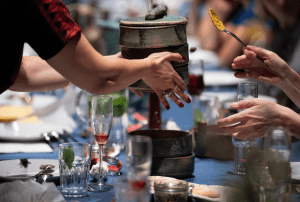
The Palestine Hosting Society started in 2017. The idea began earlier, in 2016, when I was in Japan working on a video installation commissioned by Tokyo Wonder Site.
At the time, I was working on a project called Disconcert, where I collected people’s hums—asking them to recall melodies that brought them peace in moments when the world felt chaotic. This project was shaped by the emotional aftermath of the Arab Spring. By 2016, there was a strong sense of disillusionment—the hope that people could reclaim power had turned into something much darker.
That moment pushed me to rethink my role as an artist. I needed to find meaning in what I was doing. So I asked myself: what do I love as much as art? The answer was food.
I decided to study culinary arts seriously. During my training, I realized how much knowledge existed in Palestinian cuisine that my generation had lost. There was a rupture in the transmission of culinary knowledge recipes, ingredients, and traditions were no longer being passed down.
I wanted to understand why. I began documenting recipes, especially those involving wild edible plants, and collecting the stories behind them. What fascinated me most wasn’t just the taste, but the narratives: who made these dishes, where they came from, how they were tied to specific villages and landscapes.
Palestinian cuisine reflects a deep relationship with the land. But that connection has been disrupted—not only by modernity, but by displacement and loss of land. Palestinians are historically a farming people, and that relationship to the land is embedded in the food.
The Palestine Hosting Society became a way to reclaim this knowledge. It’s about preserving not just recipes, but stories, identities, and connections to place. It’s also a form of resistance ensuring that this knowledge remains alive, not archived or forgotten.
3. Why is it important to safeguard Palestinian culinary traditions?
Reclaiming this knowledge is essential, especially for a people living under occupation. It’s a way of holding onto power our voice, our history, our identity.
Food culture becomes a tool for decolonization. By telling our own stories through food, we resist erasure. Losing this knowledge would create a void that could be filled by something else, something disconnected from its origins.
So the goal is not to treat this knowledge as something static or archival, but to keep it alive and integrated into daily life.
4. Is there a dish that has a special place in your heart?
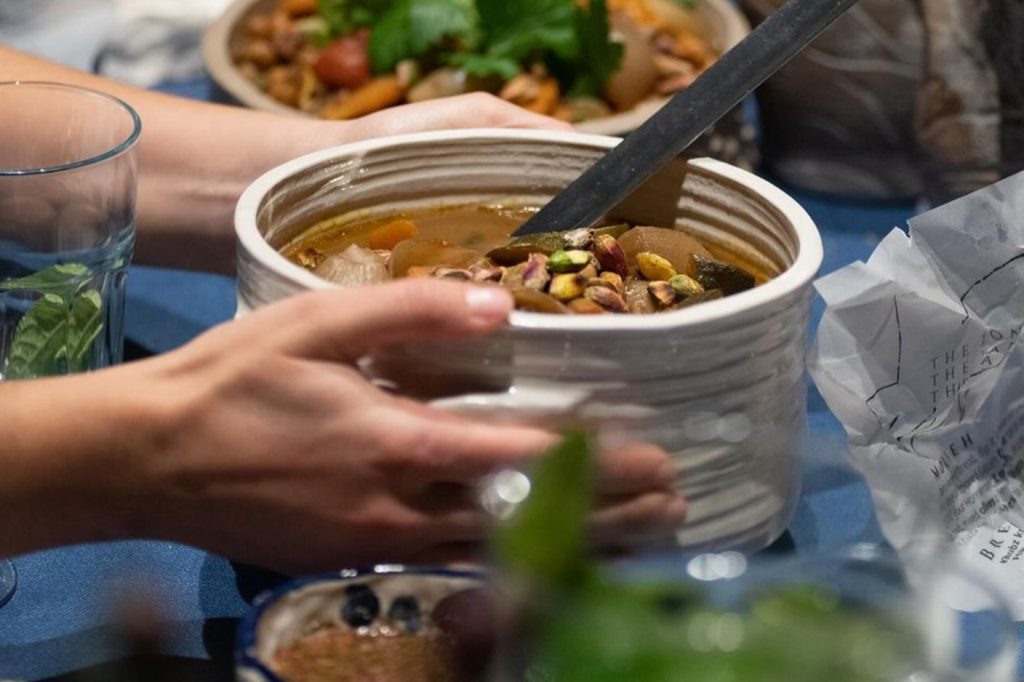
There are many, but one particularly meaningful dish comes from my family’s roots in Jaffa. It’s made with eggplants and pomegranate, cooked in pomegranate molasses and juice, with spices and topped with fried onions. It has a rich migration story it disappeared in Jaffa but was preserved in Gaza, where it evolved slightly while keeping its essence.
But recently, I’ve been thinking differently about this question. Since I haven’t been able to spend time with my family due to the war, the dish I crave most is maqloubeh, especially my mother’s version.
Maqloubeh means “upside down.” It’s a layered dish of rice, vegetables, and meat or chicken, cooked together and then flipped. In Jerusalem, we have specific versions: eggplant with lamb or cauliflower with chicken. Each region in Palestine has its own variation, depending on local agriculture.
This dish is deeply tied to memory for me. My mother always makes it when I return home after traveling. I’ve lived a very nomadic life, and that dish represents return, comfort, and belonging.
5. Do you think Palestinian culture is largely unknown?
It’s not unknown it’s dispossessed.
This dispossession has flattened Palestinian culture into broader labels like “Middle Eastern.” While there are connections with neighboring cuisines, Palestinian food has its own specificities its ingredients, traditions, and cultural meanings.
There’s also the issue of appropriation, which further dilutes Palestinian culinary identity. That’s why it’s crucial for Palestinians to tell their own stories and define their own culture.
When land, resources, and autonomy are taken, what remains are stories. Preserving and sharing them becomes a responsibility.
6. Can art help preserve culture during turbulent times?
Yes, but it’s complicated.
At the moment, I cannot perform. The situation in Gaza the famine, the violence has taken away my ability to create celebratory, communal work. I cannot host or perform when people are starving.
Instead, I’m working with other mediums installation, ceramics, fermentation. These allow me to continue creating in a different way.
Art absolutely has the power to preserve culture, but it also has the power to sustain the artist. For me, making art is a way of coping, of surviving emotionally during these times. It gives me something larger than myself to hold onto.
7. Do you see yourself as a reference for new generations?
I would like to be an inspiring figure, yes.
I know my work has influenced many artists, especially in how they approach food and tradition. What I hope younger generations take from my practice is the importance of constantly reinventing themselves.
If your work can be easily copied, then it’s your responsibility to evolve it. Find your own voice the one only you can express. That’s what makes an artist stand out.
8. Which Palestinian artists and creators should we pay attention to?
There are so many.
In music, Palestinian artists today are incredibly inspiring. I’m currently collaborating with Bint Mbareh, a singer and researcher in folkloric music, whose voice I deeply admire. I’ve also worked with sound artists like Sarah Neufeld.
In literature and poetry, beyond well-known figures like Mahmoud Darwish, I’m inspired by younger writers such as Dalia Taha and Maya Abu Al-Hayyat.
In film, I admire directors like Kamal Aljafari, Michel Khleifi, and Elia Suleiman.
There’s a powerful creative energy in Palestinian art today, across all fields.
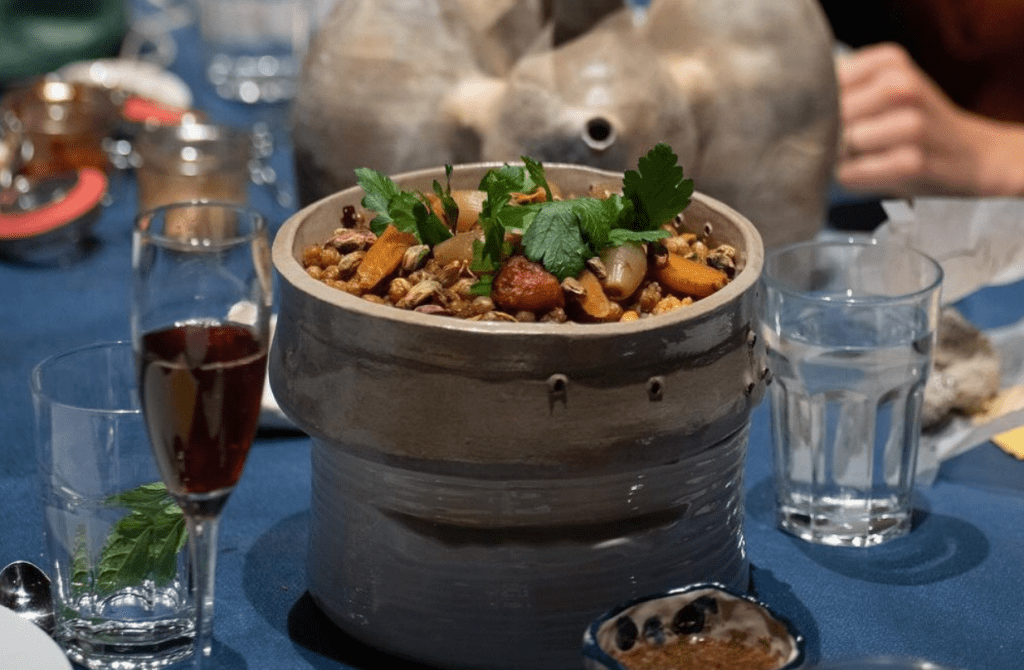
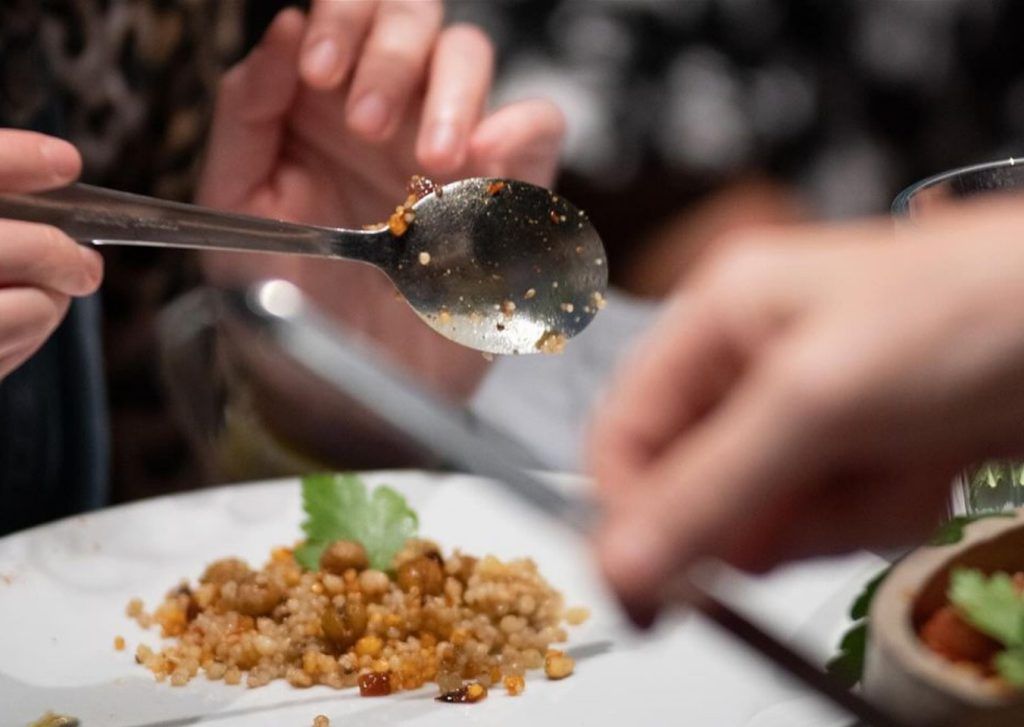
Photos courtesy of Mirna Bamieh