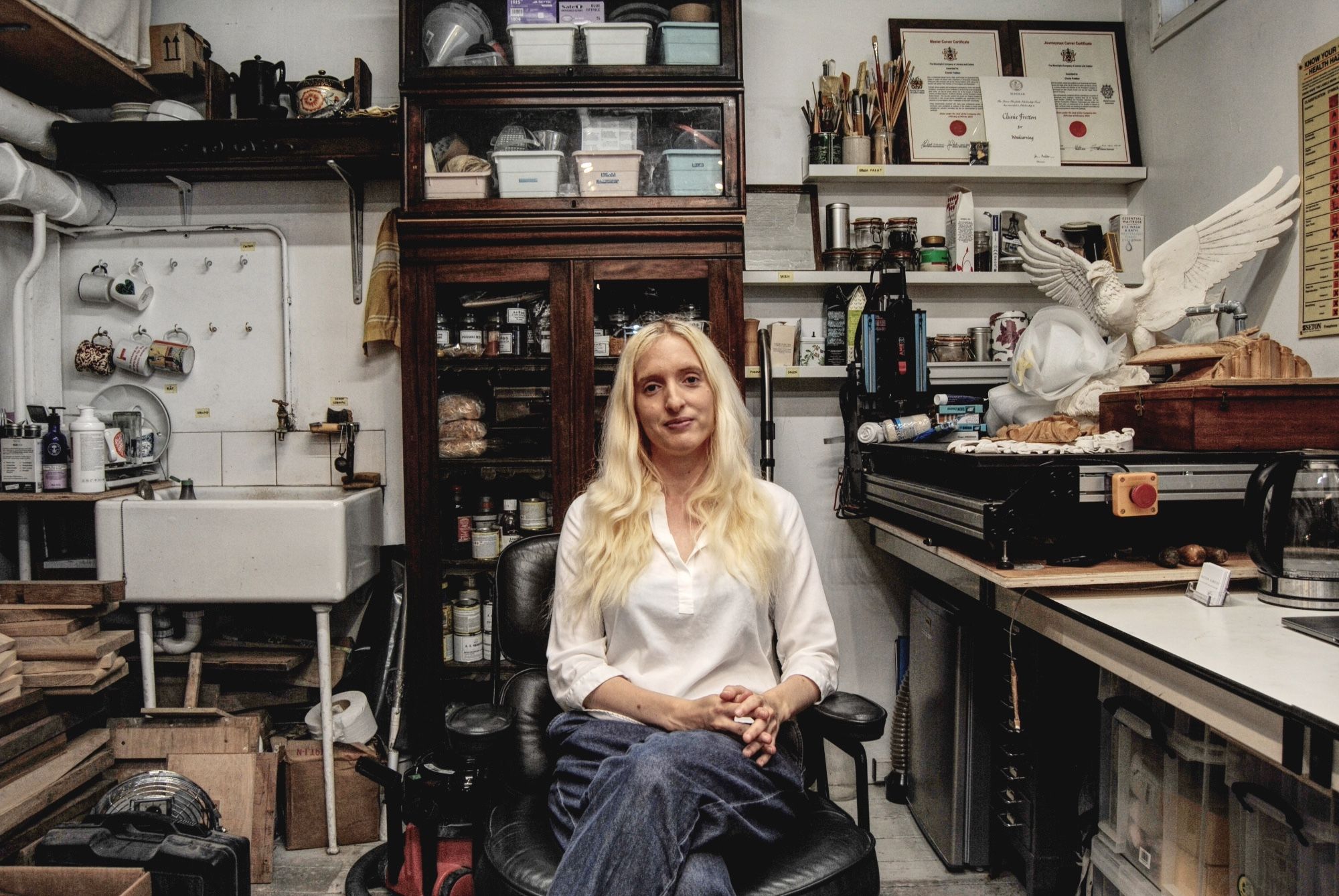
In an age of mass production and ever-evolving technology, Clunie Fretton is keeping the traditions of sculpture and craftsmanship alive through an exceptional dedication to skill, precision and the art of making by hand.
A classically trained sculptor, master carver and gilder, Clunie developed her practice at the City & Guilds of London Art School, where she studied traditional woodcarving and gilding. Today, her work spans sculpture, ornamental carving, restoration and conservation, bringing together centuries-old techniques with a contemporary creative perspective.
For Clunie, craftsmanship is about much more than the finished object. It is about the years of training, patience and accumulated knowledge behind every piece, and the importance of respecting the makers who came before us.
We sat down with Clunie to discuss her journey into carving, the relationship between art and craft, the value of traditional skills in a modern world, and her ambitions for the future of sculpture and handmade making.
1. Can you tell us a little about your background and the moment you first discovered your passion for carving and sculpture?
– There wasn’t really a specific moment when I discovered a passion for carving or sculpture. I was always interested in it, but it was more about discovering that I wanted to work in a way that was highly skilled and precise.
I was drawn to the traditions of sculpture and to learning things in a very technical way, rather than the more conceptual approach to modern art. The place I found that taught at that level was the City & Guilds of London Art School in South London. They still teach stone and wood carving in a very traditional way.
Historically, sculptors, carvers and painters would learn by copying old masters, doing lots of life drawing and working very rigorously. In Britain, a lot of that changed in the post-war period, with conceptual art becoming much more prominent.
I was also fascinated by the churches, cathedrals and historic buildings we are lucky to have in the UK. There was a sort of myth that nobody could make work like that anymore, so it was exciting to discover that people were still doing it.
2. What first drew you to working with your hands and creating physical objects?
– I think it comes from wanting to do something physical in the world. I was good at school and could write essays, but that wasn’t particularly inspiring to me.
Working at a computer and being in a purely conceptual or intellectual world didn’t appeal to me. I think most people have some desire to make things, and I’ve always had that in me.
3. Your work combines artistic vision with highly specialised craftsmanship. Do you see yourself primarily as an artist, an artisan or something in between?
– I think it’s complicated by the way the relationship between craft and art has developed over the last hundred years. There’s been a split between thinking of craft as a manual trade and thinking of art as something separate from skill and craftsmanship.
I’m definitely on the more practical side of being an artist. I want to make something that looks like the thing it’s supposed to be. I’m not particularly interested in the conceptual world of art.
But I think all good art combines high levels of skill and craftsmanship, so I don’t think they’re easily separable.
I would usually describe myself as a carver or a sculptor. That probably makes the most sense. If I say I’m an artist, people often assume I’m making conceptual art, so I then have to explain what I actually do.
4. Commissioned work often requires balancing your own creative vision with a client’s brief. How do you approach that dialogue and collaboration?
– Usually, people who commission work from me or from my partner have already seen our work and our website, so they’re generally happy with the way we work. I’m quite lucky to have clients who trust me. They give me the brief and allow me the freedom to do something good with it.
The process usually starts by discussing the price. Once that’s agreed, I’ll make a drawing, particularly if it’s a sculpture or something like a coat of arms. The client can make sure they’re happy with it and that everything required by the brief is included.
For inscriptions, memorials and plaques, this is especially important because all the text needs to be checked and signed off.
For a sculptural piece, I’ll then usually make a maquette a small model or sketch version. This helps solve problems that arise when turning a two-dimensional idea into a three-dimensional object, and it allows the client to imagine what the finished piece will look like.
It’s much easier to make mistakes in clay because you can move it, remodel it, cut pieces off or add them back on. You don’t want to discover those problems when you’re working in wood or stone.
There’s a romantic idea that a sculptor simply sees the finished sculpture inside a block of wood or stone and carves it out without making models. In reality, very few people work like that. Even traditional sculptors such as Michelangelo and Bernini made models.
Once the model is approved, the carving itself can take several months for a large piece. That’s why signing off the model is so important: the client knows what they’re going to receive.
5. You also lead workshops for architects and other groups. What interests you about sharing your creative process and traditional techniques?
-I typically teach anyone who wants to learn, although the workshop with architects was a slightly unusual situation where an architectural practice sent their office to learn from me.
It’s lovely sharing skills with people in adjacent fields. With architects, particularly, it can help them understand where the skill lies, why something might take longer than another process, and what they can actually commission.
It’s also fun for people to have a go themselves. The more people who learn to carve, the better the profession will be. Carving isn’t an endangered craft, but there aren’t huge numbers of people doing it, so it’s good to encourage more people to try.
6. Have these workshops influenced your own practice in unexpected ways?
I don’t know if they’ve influenced my practice directly, but I really enjoy teaching.
When you’re working, you often do things subconsciously. When you teach, you have to explain exactly what you’re doing and why. That makes you think about your own process in a different way.
It can be challenging, but it’s a good challenge.
7. Do you think carving, gilding and restoration are sometimes overlooked compared with fine art? Why do you think that is?
I think it’s partly a side effect of the modern art world.
Traditional craft certainly isn’t overlooked when you go to museums with older collections. Places like the Victoria and Albert Museum and the British Museum are incredibly popular, and people come from all over the world to see beautiful traditional work.
But the modern art world is a different environment. It’s also a business, and a relatively small number of major galleries and institutions can have a huge influence over what becomes fashionable.
I don’t necessarily think the general public is as excited by conceptual art as people within the art world. If you look at what people respond to, they often like traditional carving, sculpture and painting. They like being able to look at something and recognise what they’re seeing.
Social media has also shown that there is a huge audience for traditional and figurative work. There are very successful accounts dedicated to traditional sculpture and craft.
So I think there are really two different worlds: what the art world considers fashionable and what the general public actually enjoys looking at. I don’t think there’s a lack of appetite for traditional craft.
8. Restoration work often aims to be invisible, allowing the original object to speak for itself. How do you feel about creating work that may go unnoticed?
I’m quite happy with it.
Restoration teaches you how to copy something and, importantly, how to respect the work that’s already there. You can’t be egotistical when you’re doing restoration. It doesn’t matter whether you think the original work is beautiful or ugly — you have to make your work fit with it.
Sometimes you’ll have to carve in a way that you don’t personally think is beautiful, but that’s what the original piece requires. I think that’s very good for keeping you humble.
It’s also an incredible way of learning. If you’re restoring an old carving, you get to study it much more closely than you ever could in a museum. You look at every decision the original maker made. You see their mistakes, the things they did beautifully and techniques that you might not yet know how to do yourself.
With old wood carvings, you can sometimes still see incredibly crisp chisel marks hundreds of years later. Those marks can tell you so much about how the original maker worked.
You don’t always have to make work that’s shouting about your own skills. Sometimes it’s much more meaningful to make something that honours a piece that already exists and the person who made it hundreds of years ago.
9. Do you think people today fully appreciate the time, skill and craftsmanship behind each piece, or has our relationship with handmade work changed?
I think it’s definitely changed.
People have gradually become more disconnected from how things are made. Even 100 years ago, people were more likely to repair things themselves, make furniture or be connected to trades through their families.
Today, you can buy something from IKEA quickly and cheaply, without necessarily understanding how long it would take to make the same thing by hand, what the materials cost or how much knowledge is involved.
If you’ve never seen how long it takes to make a table, for example, you don’t necessarily understand why a handmade table costs what it does.
I think social media is helping because people are now exposed to more craftsmanship and more of the skills that exist. People can actually see someone making something.
There’s still a lot of lack of knowledge, but I don’t think it’s malicious. People are often fascinated and excited when they discover that these skills still exist. I always try to tell people that there are many more people doing this than they think.
10. Are there traditional techniques or professional skills that you feel are disappearing? Which ones would you most like to see preserved or revived?
There’s an organisation called the Heritage Crafts Association, which publishes the Endangered Crafts Red List. They look at different craft skills in the UK and classify them according to whether they’re viable, endangered or extinct.
They do fantastic work raising awareness, supporting endangered crafts and lobbying for greater support.
For me, I’d particularly like to see much stronger teaching and support for high-level joinery and construction skills — people who can make sash windows or carry out complicated woodwork and construction.
These skills have been neglected for a long time. There’s also been a damaging attitude that trades and craft skills are somehow what you do if you’re not academically successful. I hope that changes.
Although carving is a highly skilled trade, it’s decorative rather than essential. Nobody needs what I make; they want it. So I think the most important skills to protect are also the ones people genuinely need.
We need highly skilled bricklayers, masons, joiners and carpenters. Those trades are essential, and they deserve to be respected and supported.
11. In an increasingly digital world, what role do you think handcraft and traditional making still play in contemporary culture?
I think the further people move away from hand skills, the more they miss them.
There’s something reassuring about knowing that there are still experts out there doing things slowly and extremely well. People want to feel proud that these skills still exist.
I think that’s something everyone can appreciate. You don’t have to have a particular political position to value traditional making and craftsmanship.
I’m tentatively hopeful because these skills are being celebrated more through television, social media and online platforms. People seem genuinely excited by them.
12. Collaboration appears to be an important part of your work. What does your creative partnership with Felix bring to the process?
Felix is my partner in life as well as in business, so it’s a wonderful thing to be able to work with someone you love.
I really trust and respect his opinion. When I can’t work out what’s wrong with a piece of work, or we’re working on a larger project, we can stand back and talk it through.

We can also discuss practical things like how long a job will take or how much it will cost.
Luckily, we have complementary skills. Felix is very good at things I’m less good at, and I’m good at things he’s less good at. When we work together, we make things that we’re both happier with than either of us would have made alone.
13. You mentioned that you would love to take on more large-scale commissions. What kinds of projects, spaces or environments would you most like to work in?
The large-scale projects are interesting because they give you more time to go in depth and really think about the work.
The larger the commission, the longer the timescale tends to be, so you spend more time with the object and more time thinking about it. The people commissioning those projects are also usually very invested in them.
Public projects are particularly interesting because more people get to see the finished work.
I’d like to do more figurative work and more complicated, large-scale commissions. We’ve done a couple already and they’ve been great fun.
Even after 11 years in business, I still want to keep pushing my skills. It’s interesting to take on something complicated and see how much better you can become.
14. London has long been a centre for artistic exchange and craftsmanship. How does being based here influence your work and outlook as a maker?
It was fantastic to be able to train here. The college I attended is in London, and I’m also close to wonderful museums, historic buildings, churches and cathedrals.
The studio community is another important part of it. Being surrounded by other people making things is incredibly inspiring.
London also has a strong ability to pull work and people into its orbit. Even people who live outside London often end up taking work here.
There are obviously downsides. London is expensive and very busy, and it’s not always wonderful to live here. But in terms of what’s at your fingertips the museums, the work, the people you can meet and the opportunities to be inspired it’s a wonderful place to be.
15. What advice would you give to younger generations interested in sculpture, carving, gilding, restoration or other craft-based professions?
I would probably, somewhat controversially, say: make sure you get a practical skill first.
Craft can be difficult to make a living from because it’s often something people want rather than something they need. So I’d encourage young people to develop a practical skill they can always fall back on, and then add the artistic side.
If you’re interested in stone carving, for example, train in masonry first. That opens up more jobs, gives you opportunities to do restoration work and allows you to develop your carving alongside it.
For wood carving, I’d say learn joinery first.
We need more masons, joiners and people working in construction, and practical skills are a good investment. If you combine those skills with the artistic side, you have the best of both worlds.
Those qualifications can also give you freedom to travel because skilled trades are needed in many countries.
16. What would you like people to understand about your profession that they may not realise at first glance?
– I think people should understand how long it takes both to make something and to acquire the skills to make it.
I’ve trained for three years and have been in business for 11 years, so that’s 14 years of carving. It was probably only after around seven years of working professionally that I really felt confident in what I was doing.
When people see someone doing something highly skilled, they only see the skill. They don’t see all the years of training and practice behind it.
The cost of a highly skilled craft isn’t simply the amount of time it takes to make the object. It also reflects all the time it took for the maker to become capable of making it.
That’s part of what gives handmade objects their value. You’re getting something that is almost a distillation of all those hours, all that knowledge and all that skill.
It’s not only monetary value. There’s a kind of spiritual or intrinsic value to it. Even something as simple as a beautiful teapot can contain hundreds of years of accumulated knowledge about how to make something really well.
17. Looking ahead, what ideas, materials or ambitions are currently exciting you most?
– I’d like to do more figurative sculptural work.
There are also some materials I’d like to experiment with, although I don’t want to say too much about those yet in case they don’t work out.
More than anything, I’d like to have enough free time to make some work simply because I want to make it. I work almost entirely on commission, so most of my time is spent making things for other people.
I’d love to have one day a week to work on something of my own — to experiment, play and enjoy the process again.
When you’re working for a client, you can’t take risks in the same way because they’re paying you to make something for them. I’d like to have the freedom to experiment and let things go wrong, and hopefully discover something exciting through that process.