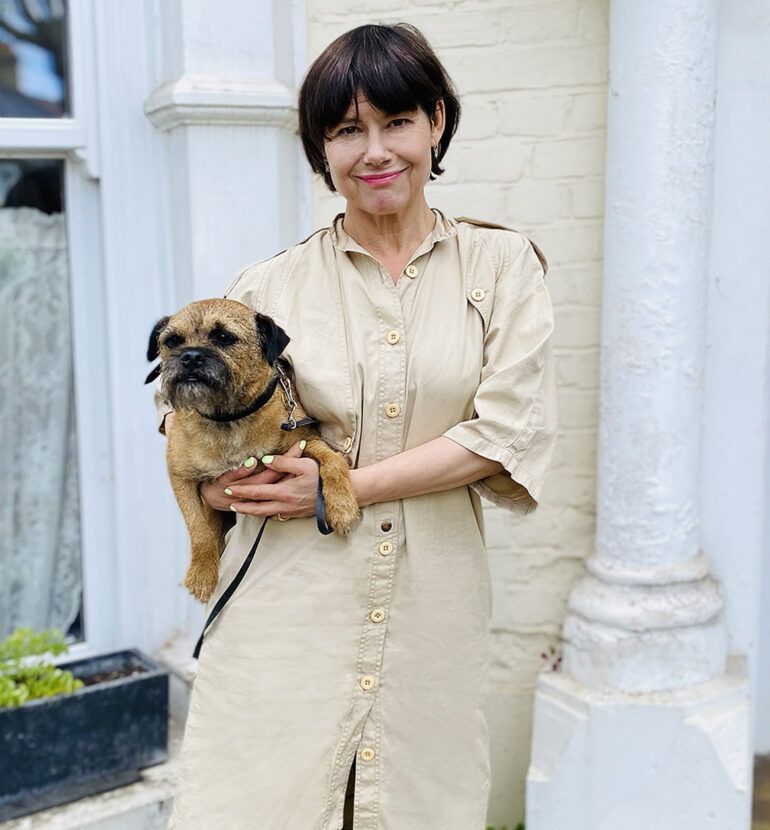
Mathilda Tham is a Professor in Design at Linnaeus University in Sweden and affiliated with Goldsmiths, University of London, and is a driving force in reshaping the fashion industry.
Known for her groundbreaking work as a meta-design researcher, Mathilda’s forward-thinking approach to predicting fashion’s future impact has gained global recognition and has positioned her as a leading expert in fashion and sustainability.
Mathilda recounts the beginnings of her professional journey and the impact on her learning. She describes how she overcame obstacles to fulfill her aspirations and imparts the advice she wishes she could give her younger self.
Mathilda Tham interview by Lina Hellgren Bullock.
– Hey Mathilda, tell me a little bit about yourself and the work you do.
– As a Professor of Design, I lead research projects focused on sustainability and have been part of creating Design + Change, a new degree program focused on design for change-making. I’m also a PhD supervisor at Goldsmiths, University of London. Together with Kate Fletcher, I run the project Earth Logic, which offers a new and radical way of imagining the fashion sector beyond the economic growth logic and has influenced initiatives in policy, education, industry, and media.
I am also a co-founder of the Union of Concerned Researchers in Fashion – a global network working to create new systems for change in the fashion industry. I have written papers and books about what roles designers can take and the methodologies they can use to make change internationally.
My work enables me to do amazing things: early morning meetings with like-minded people around the world who are passionate about the environment and social justice. Together we plan actions and create content and papers that can be used to support change in organizations and individuals. Working in education allows me to learn with students – bachelor’s, master’s, and PhDs as they figure out their way of working. In my research, I do workshops with a broad mix of fashion stakeholders exploring new ideas for the direction of fashion. My work involves many ways to explore, design, and communicate, including talking, writing, painting, singing, acting, cooking, and being with different species – such as horses, and growing things.
– Can you tell me the journey you undertook to get to where you are today?
– When I first studied fashion design, at Beckmans College of Design in Stockholm, Sweden, I tried to find an angle where fashion could contribute to social and ecological health.
After graduating, I spent a few years working as a stylist, costume designer, and trend forecaster. The experience made me feel I had to leave fashion unless I found a way to contribute to the environment and social justice. I could clearly see that fashion was creating big problems, but I didn’t have a deeper knowledge or the right tools to make a positive impact.
So, I pursued an MA in Design Futures studies, and then a PhD at Goldsmiths, University of London. My time at Goldsmiths enabled me to shift my creative practice. I started rethinking fashion, from just a “thing” you buy, wear, and dispose of, to including the idea of relationships with people and other species in the past, now, and in the future, and started working as a researcher and educator.
‘My work enables me to do amazing things: early morning meetings with likeminded people around the world who are passionate about the environment and social justice’.
– Thinking back, at the “start” of your early career, what was the outline of your hopes and aspirations?
– I didn’t have a very strong sense of what a designer does. I wanted to be creative and I wanted to do “good’’ things that would benefit people and the environment. I loved and still love being creative, love how fashion touches people, and how we can use it to express who we are and aspire to be. But the fashion industry can be very limiting, the fast cycles, and the corporate focus on money limit creativity and what a designer can make decisions about. And social media has accelerated the spread of unhelpful, norms around beauty, body ideals, and happiness.
– How have these hopes and aspirations changed throughout your career and experiences?
– Now, I feel more creative than ever, my creativity is directed at creating innovation and new ideas, ways to learn, and new stories about how we can live together, including with fashion.
-If you could take your younger self under your wings, as a career mentor, what areas and in what aspect do you feel most passionate about to put focus on?
– Be bold and keep exploring until it feels right, for you! When I was young, I had a strong sense that it wasn’t possible to be creative, intellectual, and a change agent at the same time. Now I know that it is possible, I have learned that if you don’t fit into any ready-made role, you can make up your own.
‘I feel more creative than ever, my creativity is directed at creating innovation and new ideas, ways to learn, and new stories about how we can live together, including with fashion’.
– Throughout your career, what are some memorable characteristics of other women that have influenced and inspired you?
– The coolest women I have met have been brave in doing what they believe in, even when that isn’t popular, and standing up for what they believe is right. It took me a long time to learn how not to be a people pleaser and I am much freer in my work these days. Another memorable characteristic is also women who manage to look after themselves and to have fun. I make sure I do enough fun and nourishing things to feel happy and curious. Finally, I am super inspired by strong women, and other people, who support others and contribute to a caring sense of community. I am very proud of our work at the Department of Design at Linnaeus University, we do a lot to nurture a culture of care.
– If you could push a career rewind button, do you have a “what if” regarding your career choice, what would you do differently, change or directions you would have loved to explore?

– I don’t have any regrets. Although my path was not the most straightforward, I have learned so much along the way. Also, in my current work, I learn so much every day, by spending time with people of all ages from all kinds of backgrounds. I was lucky to have the confidence to shift my career path quite early on, it is very hard work when your work does not align with your values.
‘I loved and still love being creative, love how fashion touches people, how we can use it to express who we are and aspire to be.’.
– Can you list 3 work non-negotiables you wish to remind your younger self of?
– Don’t hesitate to speak up for yourself. It’s okay if others don’t agree.
– Collaborate and surround yourself with kind people who have good values, and are knowledgeable and kind. We don’t evolve on our own but together as humans with our environment.
– Don’t worry about doing perfect things. Just try ideas out and learn from your mistakes.
‘I learn so much every day, by spending time with people of all ages from all kinds of backgrounds’.
– And finally, what’s the most important career advice you would you give to your younger self?
– You can define who you are and what your practices and professional role is. Keep your life nimble and light – then it will be possible for you to follow your heart.