An interview with Anna Farriol and Mireia Fernàndez of Engruna Teatre about creating theatre for babies, the freedom of early childhood, and how each performance becomes a world of its own.
Theatre for babies and toddlers can be a transformative experience, offering not only the little ones but also their parents new ways of seeing, feeling and connecting through a child’s eyes. To mark the return of Univers to the Barbican, following a sold-out run at the venue last year, we explore the creative process behind the company’s work.
From observing children at play to experimenting with music, movement and unconventional performance spaces, Anna and Mireia reveal how theatre can become a space for discovery, freedom and connection for babies and their families.
Could you introduce yourselves and tell us about your roles within the company?
Anna and Mireia: I [Mireia] am the company’s artistic director. Both Mireia and I perform in Univers, and we developed the original idea alongside two other collaborators.
Engruna Teatre is a women-led company, and we are all creators. We work collaboratively rather than following a hierarchical structure. We share ideas and develop our projects collaboratively. Depending on the production, each of us takes on different responsibilities, but in the initial stages, we work collectively and allow ideas to evolve.
How did the idea for Univers come about? What inspired you to create the production?
Anna and Mireia: We spent a lot of time thinking about how to create a performance for very young children. Univers was our first production for babies, and it is still our only show specifically created for this age group. The show premiered five years ago and has since been performed hundreds of times around the world.
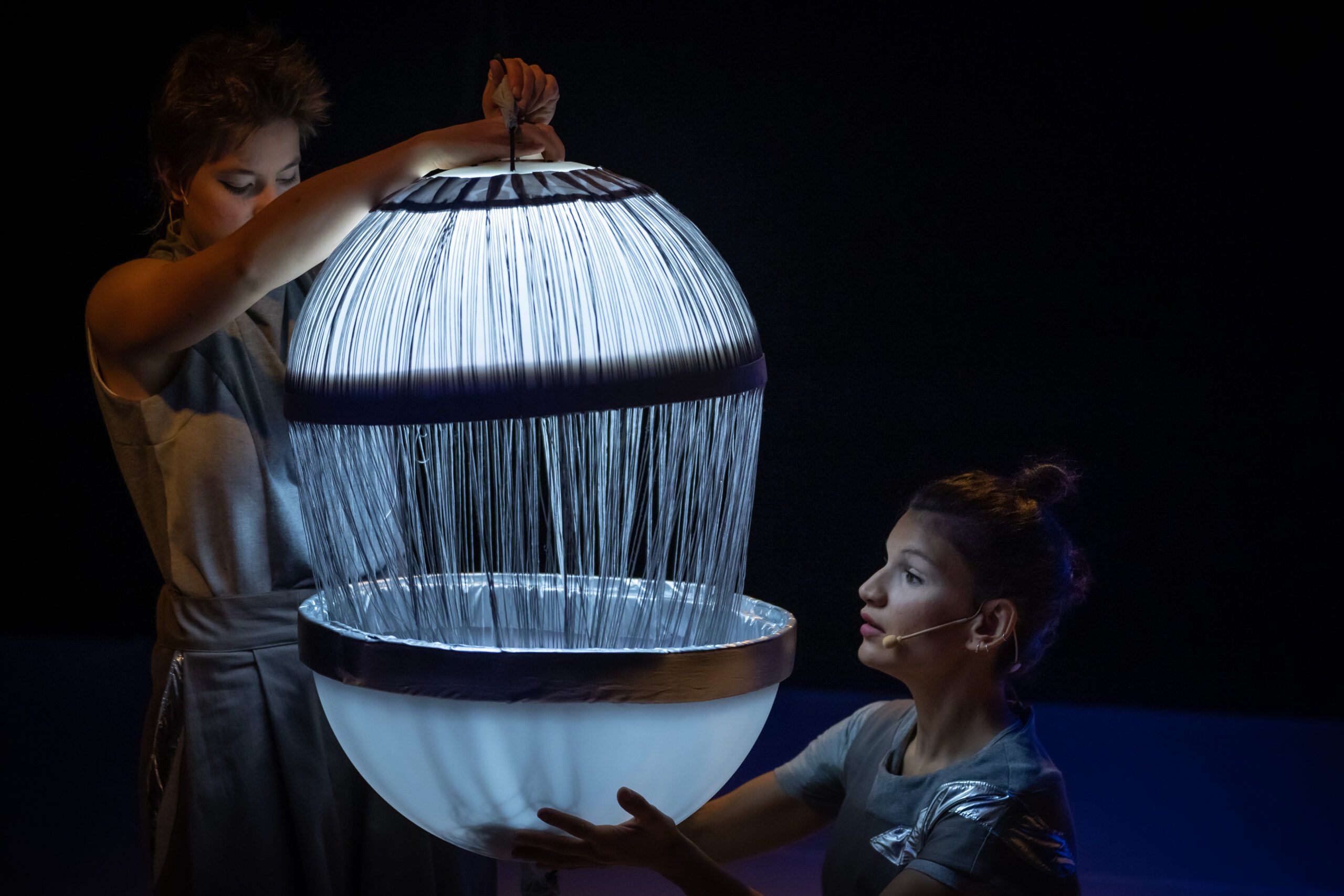
We began by observing children: how they play, how they relate to one another and how they connect with objects. At the same time, we explored concepts associated with the universe, such as balance, order and disorder.
We then developed workshops with children in nursery schools. We observed how they played with different objects and discovered what interested them most and what did not. It was fascinating to see how differently they responded to the same materials.
When we look at the universe, we see planets, stars, meteorites and countless other objects. At first, it might seem as though everything is in disorder, but every object has its own place. Somehow, everything finds a balance.
We wanted to explore the same idea with babies. What happens when we arrange objects in a particular order? What happens when we change that order? Do children prefer things to be organised, or do they enjoy disrupting them?
We experimented with these possibilities during our workshops. We brought these ideas into the workshops, introduced different objects and observed how the children responded. Through that process, we gradually created the performance.
Music and sound also play an important role in Univers. How did you discover what worked best for the babies?
Anna and Mireia: We explored how babies responded to different kinds of music and discovered that electronic music worked particularly well. Its steady rhythm seemed to capture their attention, and they enjoyed it.
This encouraged us to think about creating an atmosphere through different sounds and instruments, including the electric guitar. Initially, we might not have imagined using electronic music or an electric guitar in a show for babies, but the workshops opened our minds. They showed us that we could not simply assume what would work for young children. We had to experiment, observe and discover alongside them.
At what age do you think children can first experience theatre?
Anna and Mireia: We believe children can begin experiencing theatre at a very early age. Of course, a newborn baby will engage with a performance differently from an older child. In the first weeks of life, babies are still developing their vision and need close contact with their families.
Around five or six months, however, they often begin to show greater interest in the world around them and develop more mobility. This can be a wonderful time to introduce them to this kind of experience. Younger babies can also enjoy Univers through the music, sounds and atmosphere.
It depends on what we mean by participation. If we want babies to interact with us, explore the objects or connect with other children, their experience will change as they grow.
We have seen babies return to Univers at different stages of their development: first at two months, then at eight months, and later at one year or eighteen months. Each visit is a completely different experience.
What has surprised you most about the way children and families respond to Univers?
Anna and Mireia: Many things have surprised us. One particularly interesting aspect of touring internationally has been noticing cultural differences. It is fascinating to see how cultural influences can already be observed in children as young as eighteen months.
We are also continually surprised by what happens when we allow babies the freedom to be themselves. When we give them space without constantly directing or instructing them, they can surprise us just as much as adults do.
Sometimes parents discover something new about their own children. They might realise that their child is braver, funnier or more curious than they had imagined.
As adults, we do not always give children enough space to express themselves. We sometimes forget that, even though they are small, they already have their own interests, personalities and ways of exploring the world. It is wonderful to see how parents react when they make these discoveries.
The way the audience is arranged seems to be an important part of that freedom. Could you explain how it works?
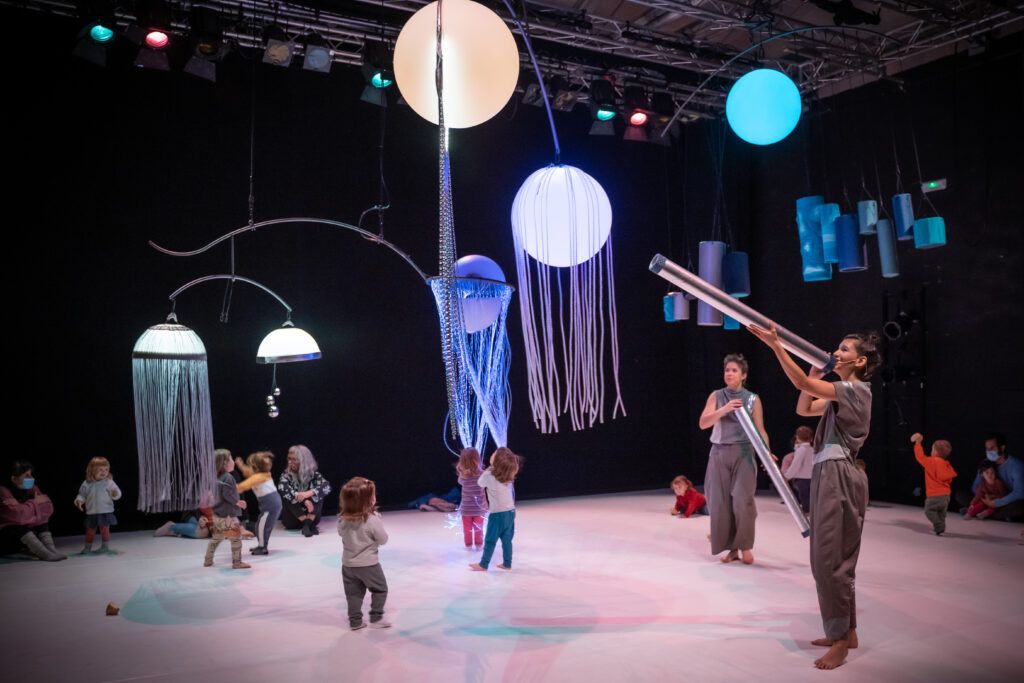
Anna and Mireia: Before the performance, we give families a few instructions. Parents stay on the floor around the perimeter of the performance space; they are asked not to enter the stage area. If a baby wants to explore the space or approach an object, they must make the journey themselves, without their parents accompanying them.
This is important because it allows us to see how parents respond when their children are given the freedom to explore independently. Sometimes, the adults feel more nervous than the babies!
Occasionally, we’ve had the privilege of witnessing a baby take their first steps during the show. It’s an incredible experience. Perhaps they spot an object they want to reach, but their parents can’t go with them. This may encourage them to take their first steps on their own.
These moments are magical. It becomes a very special experience for the child, their family and us as performers.
This will be your second time presenting Univers at the Barbican. How does it feel to return, and can audiences expect anything different?
Anna and Mireia: It is a real honour to return to the Barbican. We are incredibly happy to be back. It was such a wonderful experience the first time, and we are very grateful to have the opportunity to come back to The Pit.
Every performance will be different because it depends so much on the children and families who take part. We have a structure for the show, but no two performances are ever the same.
A group arriving at ten in the morning might be completely different from one arriving at three in the afternoon. The children may be tired, full of energy or ready to sleep. Even the atmosphere of the day can make a difference.
Babies are very sensitive to their surroundings, whereas adults tend to arrive with more fixed expectations about how things should happen. The energy of a group can shape the entire performance.
Sometimes, a group is full of energy and we have to respond with more dynamism. At other times, the atmosphere is calm, perhaps because the children are very young or tired, and we need to soften our approach.
How do you adapt the performance while keeping its structure?
Anna and Mireia: We have choreography, but it is flexible. The children interact with the objects, we respond to them, and they respond to us. It is a continuous exchange.
We have to read the energy of the group and adapt the performance accordingly. Do we need more energy? Should we slow down? Are the children feeling uncertain and in need of a gentler approach? Or are they toddlers, perhaps around two and a half years old, who are ready for something more energetic?
We can often sense the atmosphere before we even enter the performance space, while we are giving the families their initial instructions. The energy also depends on the children’s ages, the time of day and the cultural context.
Sometimes one very energetic baby influences the whole group. At other times, one calm child helps everyone else settle. It is fascinating to see how they connect with one another. Each performance becomes its own little universe.
Does that unpredictability present a challenge?
Anna and Mireia: Absolutely, but it is also part of the magic. Babies do not necessarily know that they are going to the theatre. They do not arrive expecting to sit quietly in a particular place and behave like a conventional audience. They simply experience what is happening in the moment.
They do not have the same expectations that adults have about how a performance should unfold. That freedom is wonderful, but it is also a challenge for us. We must remain open and responsive to whatever happens.
It makes Univers a shared experience for the whole family. Everyone is discovering something together.
Are there any ideas or projects you would like to explore in your future work? Anna and Mireia: We have been thinking about what might come after Univers. The show looks towards what is above our heads, so we began wondering about what lies beneath our feet.
We are connected to the ground and to the universe, but how do we understand that connection? We want to explore what it means to be here, on the earth, and how we are connected to the land.
We are thinking about creating another show for very young children, one that is not about the universe but instead explores roots, seeds and what we need in order to grow. It would be a different subject, but we would continue asking questions through observation, experimentation and the experiences of young children.
For us, the process always begins with curiosity: discovering something, trying it out and seeing what happens when we share it with babies.
In Univers, the smallest gestures can open up an entire world. By giving babies the freedom to explore on their own terms, Engruna Teatre creates a space where children and adults can discover one another anew and where every performance becomes a universe of its own.
Univers returns to The Pit at the Barbican from 2–12 December, following a sold-out run at the venue last year. The production by Engruna Teatre continues its award-winning international tour and has received international acclaim for its innovative approach to theatre for very young children, creating an immersive experience that invites babies and their families.
Photos: Arian Botey Soldevila.